A Path to Try
Collaborator has twelve workflows. You do not need all of them on day one. The path below matches the craft order in Writing with StoryCAD: idea and premise first, then problem and character force, then structure and scenes.
You can skip steps, but this order usually wastes less time.
The starred band is a head start
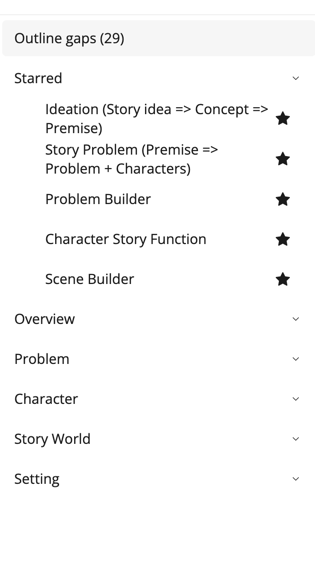
Collaborator starts with five of these workflows starred, so they sit at the top of the workflow list before you touch anything: Premise, Story Problem, Problem Builder, Character Builder, and Scene Builder. That is one per stage of the spine below, so the top of the list reads as a next step rather than a catalog.
Treat it as a starting point, not a rule. As you learn which workflows your writing turns on, star those and unstar the rest. Opening Collaborator shows how. Everything not starred is still there, filed under its story element.
Suggested order
-
Premise
Nail a workable premise from idea and concept.
Craft: Story Idea, Concept, and Premise -
Story Form (when you care)
Genre and story type (novel, screenplay, and so on). Useful once the premise exists. -
Story Problem
Turn the premise into a main problem with protagonist and antagonist shells.
Craft: Defining Problems -
Problem Builder
Goal, motivation, and conflict for both sides of that problem, then a beat sheet that fits it. Scenes and Problems that sit on no beat sheet yet fill its empty beats, and scene stubs fill the rest. Set Problem Category, Protagonist, and Antagonist on the Problem first: Problem Builder reads all three, and a blank category stops the run before it starts.
Craft: Defining Problems (GMC), Plotting with StoryCAD -
Inner and Outer Problems
Outer want versus inner need.
Craft: outer and inner problems in the same Defining Problems material -
One character path
For example Character Builder, then Flaw and Backstory.
Craft: Defining Characters -
Scene Builder
Sketch, type, cast, development, conflict, and sequel for one scene. Select the scene first: Scene Builder fills a scene you already made.
Craft: Defining Scenes, Plotting in Scenes
Teaching tip
For a class or critique group, assign one workflow per session and require students to accept or reject each field deliberately. The point is judgment, not speed.
What to leave for later
Image-generation workflows, deep redesigns, and specialty tools can wait until the spine above feels solid. A short list of workflows that actually improve a story beats a long menu of experiments. Leaving them unstarred keeps them out of your way without putting them out of reach.