Structure Tab
The Structure tab defines what kind of world your story is set in. This fundamental choice guides your worldbuilding approach.
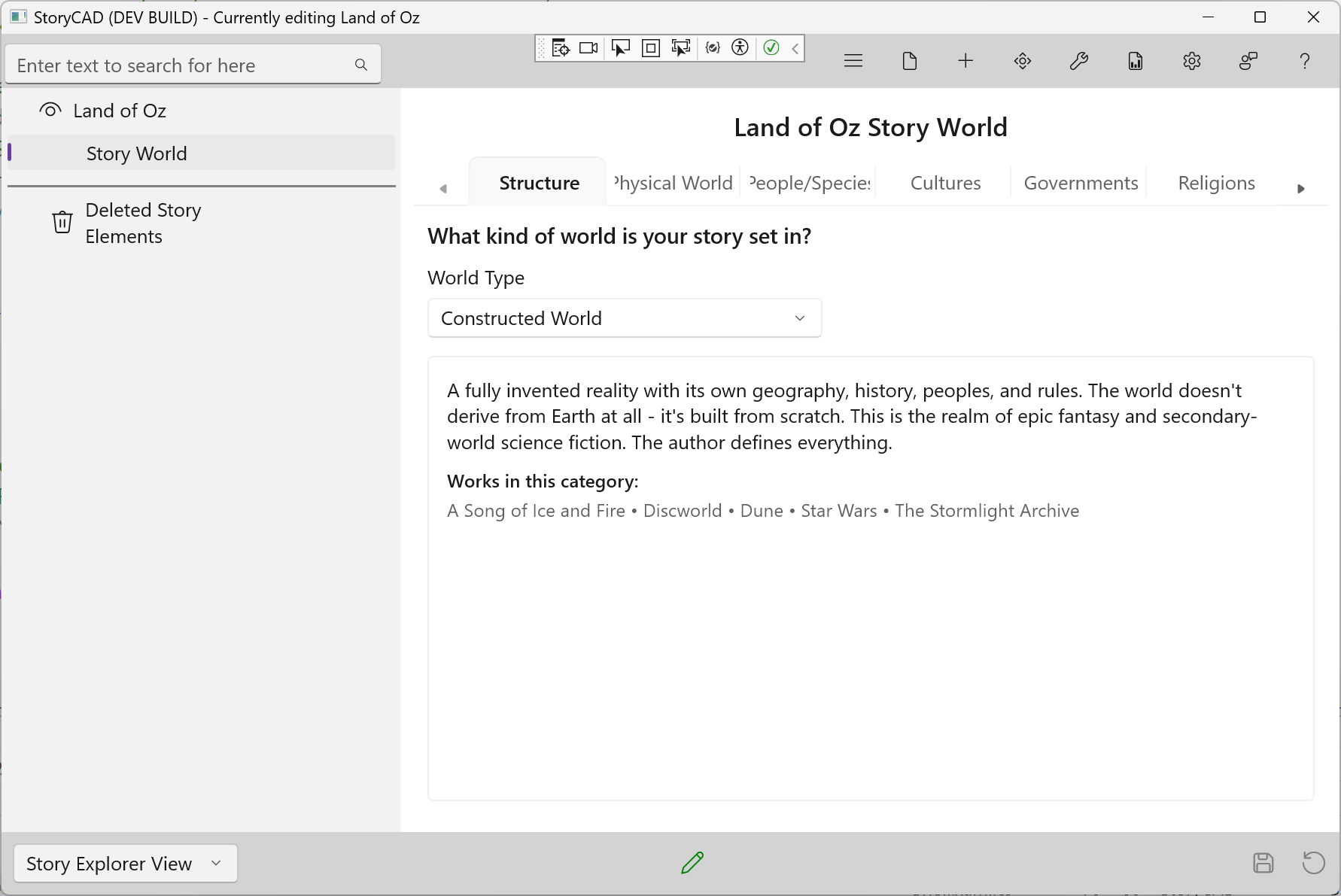
World Type
Select the World Type that best describes your story’s relationship to reality:
| World Type | Description | Examples |
|---|---|---|
| Consensus Reality | Our world as we know it | Mysteries, legal thrillers, literary fiction |
| Enchanted Reality | Our world with a touch of magic or wonder | Magical realism |
| Hidden World | Magic or supernatural hidden within our world | Harry Potter, Dresden Files |
| Divergent World | Our world with one key historical change | Alternate history |
| Constructed World | An entirely invented world | Lord of the Rings, Dune |
| Mythic World | A world of legend, prophecy, and fate | Classical mythology, epic fantasy |
| Estranged World | A familiar world made strange | Dystopian fiction, Kafka |
| Broken World | Post-apocalyptic or collapsed civilization | The Road, Hunger Games |
When you select a World Type, StoryWorld displays a description and example works to help confirm your choice.
Why World Type Matters
Your World Type selection helps you focus your worldbuilding effort:
- Consensus Reality stories need research into real-world settings and subcultures
- Hidden World stories need rules for how magic stays hidden
- Constructed World stories need comprehensive worldbuilding across all tabs
- Broken World stories need to define what collapsed and what remains
Tips
- If your story doesn’t fit neatly into one category, choose the closest match
- You can always change the World Type as your story develops
- The World Type guides your thinking—it doesn’t limit what you can create