Physical Worlds Tab
The Physical Worlds tab captures the geography, climate, and natural features of your world. This is a list-based tab—you can add multiple entries for stories with multiple worlds, planets, or realms.
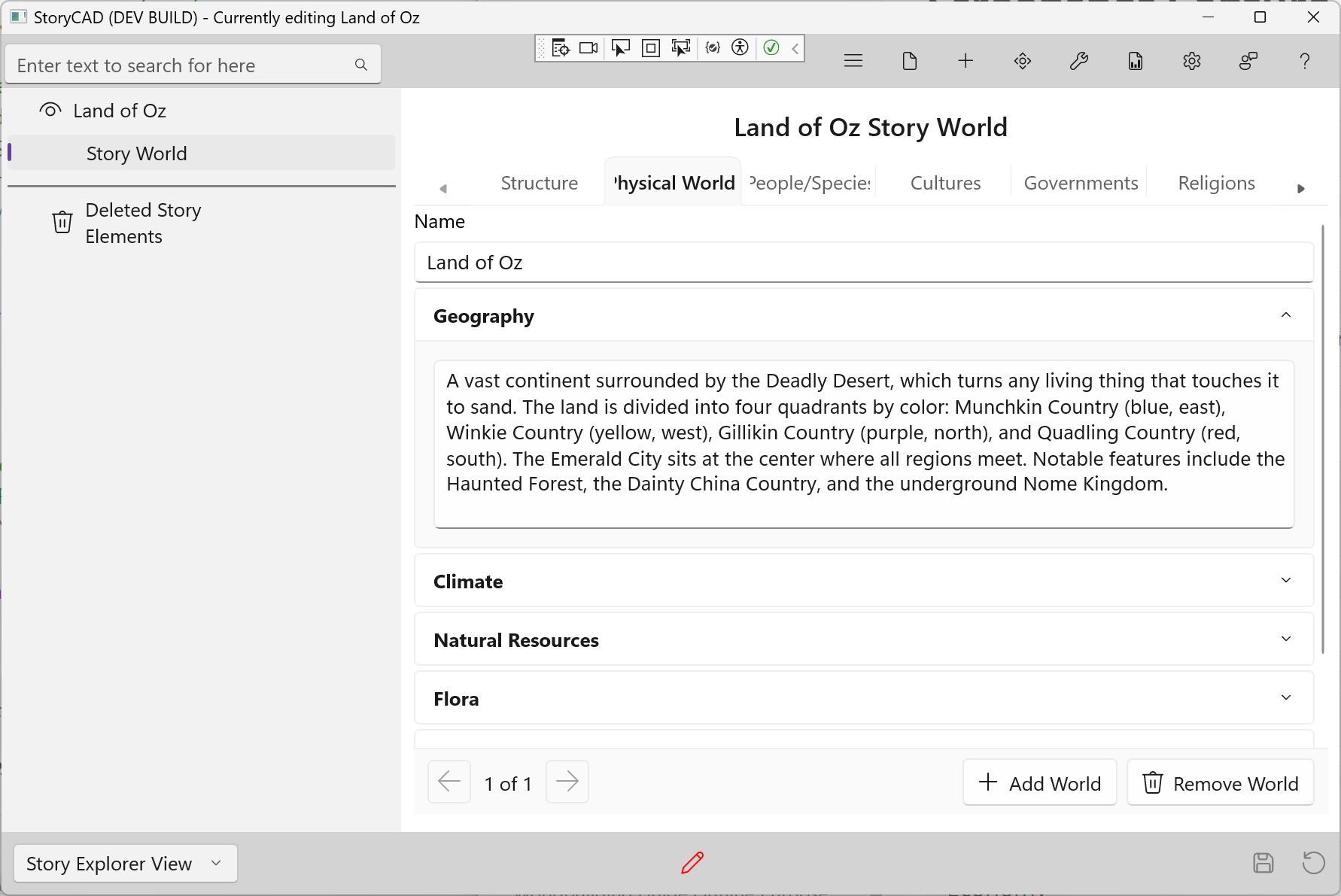
For most stories, you’ll create a single entry. For portal fantasies, space opera, or multiverse stories, create an entry for each distinct world.
Adding and Navigating Entries
- Click + Add World to create a new entry
- Use the Prev and Next buttons to navigate between entries
- The position indicator (e.g., “2 of 5”) shows your current location
- Click Remove to delete the current entry
Fields
Name The identifier for this world—”Earth,” “Middle-earth,” “Mars,” or “The Upside Down.”
Geography Terrain, landforms, and bodies of water. Mountains, rivers, deserts, and seas shape travel, settlement, and conflict. Consider how geography creates natural boundaries and routes.
Climate Weather patterns, seasons, and temperature ranges. Climate affects daily life, agriculture, clothing, and architecture. Unusual climate can define a world.
Natural Resources What’s available and what’s scarce? Resources drive economies, cause conflicts, and constrain what’s possible. Consider minerals, water, food sources, and energy.
Flora Plant life in your world. Familiar plants ground readers; unusual plants create wonder. Consider how plants affect food, medicine, materials, and hazards.
Fauna Animal life in your world. Animals provide food, labor, companionship, and danger. Fantastic creatures can define a world’s character.
Astronomy Moons, stars, and celestial features. Multiple moons affect tides and calendars. Visible galaxies or strange skies remind readers they’re not on Earth.
Tips
- Geography shapes civilization—consider how terrain affects your cultures
- Specific details make settings memorable (not “a forest” but “ancient oaks draped in moss”)
- Scarce resources create conflict; abundant resources shape economies
- For single-world stories, one detailed entry is better than multiple sparse ones